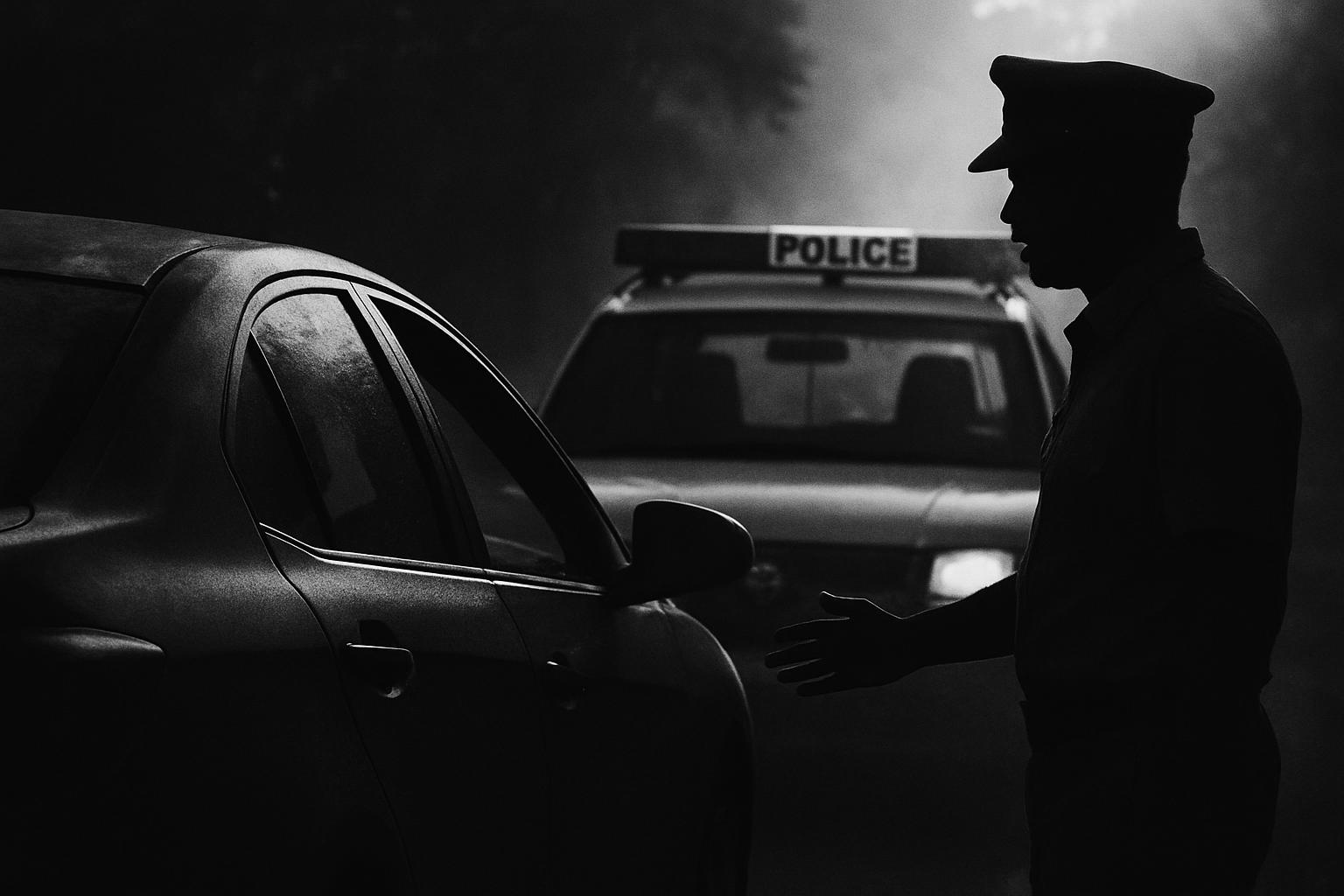
Karnataka High Court Stay On FIR Over Overtaking Puts Policing On Notice
Karnataka High Court Stay On FIR Over Overtaking Puts Policing On Notice
By pausing an FIR against three motorists accused of overtaking a Malur judicial officer’s private car, and by questioning the officer’s conduct, the Karnataka High Court has pressed for restraint when criminal law is invoked in routine traffic settings.
 Veera NairTET TV Anchor — India Desk
The Karnataka High Court has done something simple and important. It has stayed an FIR against three motorists who allegedly overtook a Malur judicial officer’s private car, and it has asked why the officer acted as she did on a public road. The order, reported by The Hindu, does not end the case. It freezes the investigation and demands reasons for using the criminal process in what looks like ordinary traffic behaviour.
What a stay means
A stay on an FIR is a checkpoint. Police steps are halted so the court can test the legal and factual basis for a case. It is not a quashing. It is not an acquittal. Here, the bench chose to stop the FIR process and to ask why an overtaking episode involving a private car of a judicial officer should trigger a criminal probe. That narrow act carries a wider message that matters in daily life.
A stay is a timeout, not a terminus, and it forces clarity on why the criminal machinery was set in motion.
Two details stand out from the report. First, the allegation is overtaking. Second, the court pointed to the conduct of the judicial officer on a public road. Read together, they explain why the bench paused the case. The issue is not only the drivers. It is also how officials behave in a space shared by all citizens.
Keep traffic in the traffic lane
India’s roads see millions of interactions every day. Lane changes, overtakes, the odd word exchanged at a signal. These belong to traffic regulation. When police register a criminal case in such a setting, it turns a routine moment into a coercive process. There is risk of arrest, trips to court, and the shadow of a record. A court that resists such escalation is saying that criminal law is a scarce and heavy tool, kept for conduct that truly warrants it.
The Hindu report does not speak of violence, weapons, or injury. It describes an overtake and a subsequent FIR. The decision to pause that FIR emphasises fit between facts and forum. If facts speak the language of traffic control, the state should use that language. Criminal prosecution is not the default tool for road etiquette.
Guidance for police discretion
For officers on the ground, interim orders like this are practical guidance. Distinguish between behaviour that calls for a traffic challan and behaviour that suggests criminal suspicion. When the complainant is a public official in a private capacity, that discipline is even more important. The appearance of using the criminal process to remedy personal inconvenience corrodes public trust.
Expect more careful screening at the station house when complaints flow from ordinary driving. Officers can document the incident, issue challans where needed, and escalate only when there is a clear public safety dimension. The High Court’s stance encourages that laddered approach. It does not tie police hands. It asks for discernment and recorded reasons before choosing the most intrusive route.
Citizen rights in everyday policing
Everyday policing is where most citizens meet the state. A stop on the road, a request for documents, an allegation of rashness. These touchpoints shape confidence in law and authority. By questioning the move to convert an overtaking incident into a criminal case, the court affirms two principles. Official status does not turn private irritation into a criminal wrong. Investigative power needs facts that go beyond annoyance.
This is not a nationwide precedent. It is an interim order rooted in one fact pattern. Even so, interim scrutiny matters. It sets expectations for both citizens and the police. It tells courts to test the threshold for criminalisation in quotidian settings. It reminds complainants, including public servants, that their own conduct on public roads will be examined.
Boundaries for official conduct
The court’s questions about the Malur judicial officer’s conduct are noteworthy. Public roads are shared spaces. A judicial officer, a police constable, a teacher, a student, all are simply drivers in private vehicles. The standards of politeness and legality are the same. By calling attention to the officer’s role, the bench framed the incident as mutual, not hierarchical. That framing resists status driven policing, where rank dictates outcome.
Courts often use interim orders to prevent process becoming punishment. Staying an FIR in a case like this keeps the balance. If the matter is to proceed, it must do so on a considered legal footing, after allegations are tested against the right threshold. If it is not to proceed, the individuals avoid needless entanglement.
What to watch
Two developments bear watching. First, whether police refine internal checks for traffic linked complaints from private road interactions that involve officials. Even small measures, like supervisory review before registering a criminal case in such situations, can reduce friction. Second, how magistrates and trial courts apply this spirit when authorising investigative steps in similar cases.
The Hindu account is clear. The bench has not shut the door on inquiry. It has said stop, explain, and justify. That careful calibration is the hallmark of judicial oversight in high volume contexts like traffic. It protects citizen rights without disabling lawful enforcement. It invites police to pick the right tool for the right task and to record why.
The Karnataka High Court has, through a targeted stay and pointed questions, reframed an everyday road incident as a test of process integrity. That is the story. Not a sweeping doctrine. A reminder that criminal law belongs at the end of the ladder, when the traffic rulebook will not do.