Malvinas Banner As Quiet Statecraft: Tournament Pageantry Restates Claims, London Channels Fallout To FIFA
Malvinas Banner As Quiet Statecraft: Tournament Pageantry Restates Claims, London Channels Fallout To FIFA
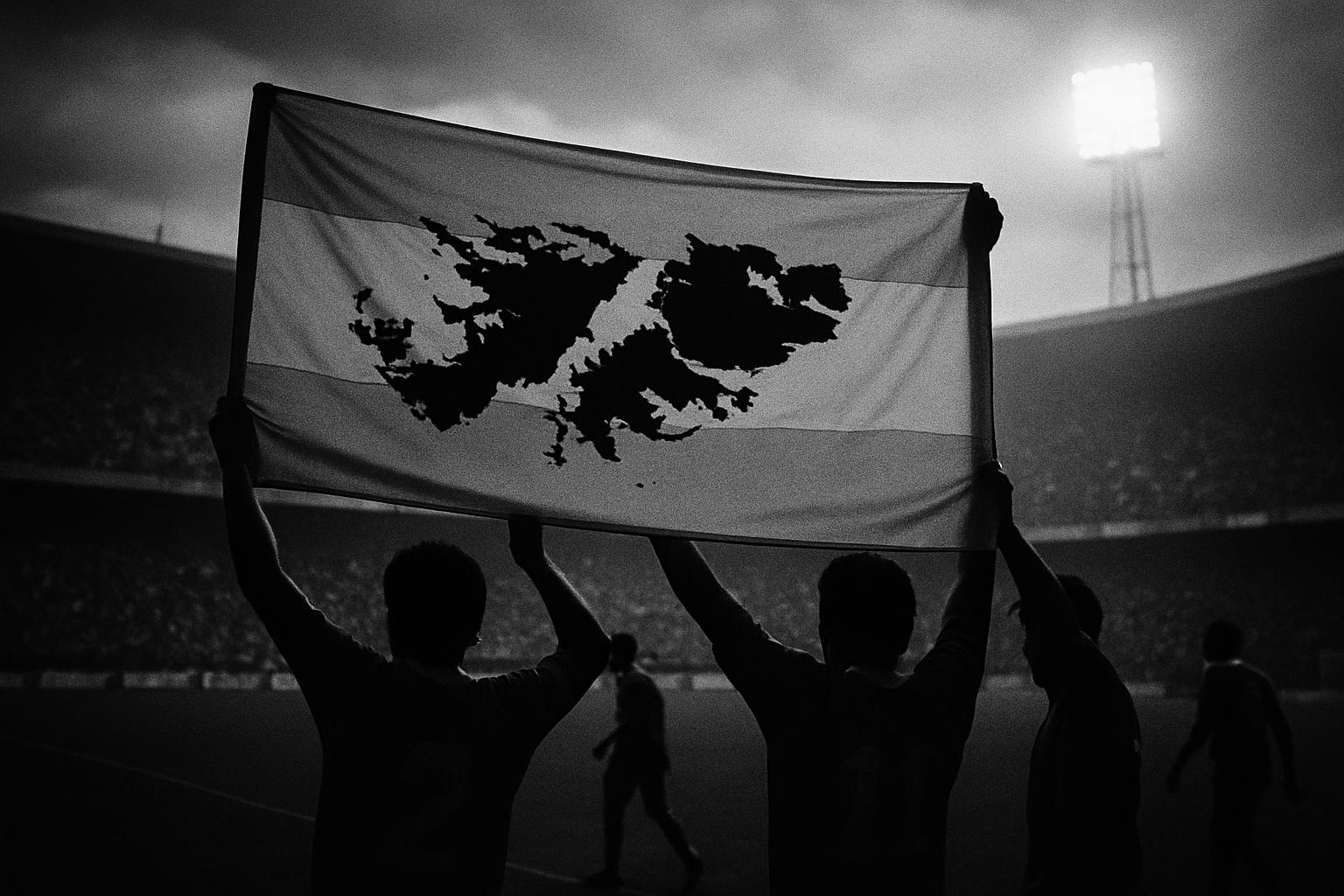
Argentina’s players raised a Las Malvinas son Argentinas banner after beating England, a reminder that tournament rituals can carry territorial arguments at little diplomatic cost, while a British minister steered any fallout toward FIFA rather than government channels.
 Adrian ValeWorld Correspondent
The image was not a flourish. After a late comeback against England in Atlanta, Argentina’s players unfurled a banner that read Las Malvinas son Argentinas, a statement about the islands Britain calls the Falklands. The Guardian reports the banner appeared after the semi-final, that Lisandro Martínez and Giovani Lo Celso displayed it to the stands, and that its origin in the stadium was unclear.
The message sits on known ground. The Guardian notes the islands are the subject of a dispute that produced a 74-day war in 1982, and records the loss of more than 900 people, including 649 Argentinians and 255 Britons. In football terms this was a moment of release, a 2-1 win secured in the final minutes. In political terms it was a familiar use of the big stage, where symbols travel fast and official costs can be kept low.
The gray zone of stadium politics
FIFA’s stadium code of conduct bans banners and paraphernalia of a political nature. The Guardian reports that FIFA did not immediately reply to a request for comment. That silence, combined with the rulebook’s breadth, describes a zone where messages can appear before adjudication catches up. Public display comes first, process later. Within that timing, pageantry does the work.
The source offers a second example. In Los Angeles last month, Iranian Americans waved pre-revolutionary flags when Iran played, described as symbols of protest against the Tehran government. Those matches proceeded without incident. The pattern is not subtle. In venues designed for spectacle, political symbols surface as fan gear or celebratory props, and they tend to move faster than enforcement.
The mechanism is straightforward. The stage is global. The artifacts are simple to carry. The provenance can be murky, as The Guardian observed in Atlanta. Even when codes prohibit political content, the incident is processed through sporting channels. That keeps the frame on discipline or security, not on bilateral diplomacy.
What was said, and what was not
The Guardian quotes Lisandro Martínez saying he could picture a Malvinas veteran weeping, and that the act asserted that the islands belong to Argentina. Leandro Paredes called it a sad part of history and said the team knew they were playing for those affected. These are player voices, not state policy. The source does not connect the gesture to government orchestration, and it reports that the banner’s origin was unclear.
On the British side, the reaction reported was narrow and procedural. The business secretary, Peter Kyle, called the display entirely inappropriate, said politics needs to be separate from football, and said the matter is for FIFA to investigate thoroughly. That phrasing routes the event to the tournament’s own machinery. It keeps the government’s presence to a statement of principle and a referral to the organizer’s rules.
Argentina’s security minister, Alejandra Monteoliva, speaking about celebrations and security, said there would be 1,600 officers and that entry of elements with provocative messages is prohibited. That is a reminder that the same codes that sometimes lag in real time are also cited by governments when they want calm around a final.
Public display comes first, process later.
Pageantry as a restatement device
The Guardian’s reporting locates three features that make tournament symbolism durable. First, repetition. The chant after the quarter-final referenced the Malvinas, linking on-field progress to a historical claim. Second, plausible deniability. The banner’s source is unclear, which allows separation from formal institutions even when players carry it. Third, procedural containment. With FIFA’s code in place and a minister in London pointing to that code, the arena for consequence is administrative rather than diplomatic.
This is why such gestures recur. They are legible to domestic audiences and diaspora communities watching from afar. They can be delivered in seconds, photographed in an instant, and circulated for days. They pull in history without requiring a communique. They can be condemned as inappropriate without inviting a formal exchange of notes. The Guardian’s account shows each of these levers in motion.
Why the symbolism will likely stand in public view
What happens next is already signposted in the source. FIFA did not immediately reply to a request for comment. A British minister framed the incident as a matter for FIFA. Argentina’s security chief emphasized prohibitions on provocative messages as the final approaches. None of this requires a new diplomatic script. The images will persist online and in memory. The consequences, if any, will be described in terms of stadium rules.
The match itself goes on. Argentina faces Spain in New Jersey on Sunday, as The Guardian reports. Whatever the final score, the semi-final supplied a separate outcome. A message about the Malvinas reached a global audience. It did so through the rituals of sport. It did so without the formalities of statecraft. That is the point of the stage.